Wobble: Infusing Life and Movement into Modern Typography
In the crowded landscape of digital design, the primary challenge for many creatives is breaking through the visual noise. Traditional typography, while legible and professional, can sometimes feel static and uninspired, particularly when the goal is to capture attention instantly. This is where the need for expressive, character-driven typefaces arises. Designers and brand strategists often search for fonts that do more than just present information; they seek typefaces that tell a story. This is the specific environment where Wobble thrives, offering a solution that bridges the gap between professional legibility and artistic expression.
Understanding the Anatomy of Wobble
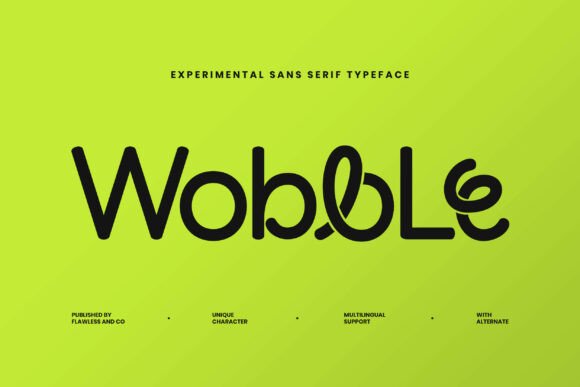
Wobble is not merely a font; it is an experimental sans serif designed to disrupt the monotony of standard grid-based layouts. It is characterized by its bold, playful nature and its refusal to adhere to the rigid rules of traditional typography. The defining feature of Wobble is its dynamic movement. Unlike static geometric fonts, the letterforms in this family appear to dance. They feature twisted terminals—most notably visible in the curve of the letter 's'—and smooth, unconventional curves that give the text a rhythmic, offbeat flow.
From a technical perspective, Wobble falls under the category of an experimental artistic sans serif. However, its tone is versatile, oscillating between futuristic and human-centered. It is edgy without being illegible. The creative ligatures found in characters like 'u' and 'm' allow the letters to connect and interact in ways that mimic handwriting or fluid motion, creating a sense of immediacy and personality that is often missing in digital media.
Addressing the Challenge of Brand Personality
One of the most significant hurdles in modern branding is the "sea of sameness." Many brands default to safe, neutral typefaces to ensure safety, but this often results in a lack of distinct identity. The goal for many startups, fashion labels, and creative agencies is to project confidence and uniqueness. Wobble addresses this by serving as a visual anchor for brand personality.
When a brand uses Wobble, it signals a willingness to be different. The font's inherent energy makes it an ideal candidate for work that calls for unconventional charm. For example, a lifestyle brand targeting a younger, more adventurous demographic might use Wobble for headlines to convey a sense of fun and spontaneity. Conversely, an art-forward gallery might utilize the font to suggest that their content is modern and conceptual. By implementing Wobble, designers can instantly elevate a layout from functional to expressive without needing complex graphic elements to carry the weight of the design.
Practical Applications and Versatility
The utility of Wobble extends across various mediums, making it a practical tool for diverse creative workflows. Its bold structure ensures that it remains impactful whether used in large-scale print or digital screens. Here are specific scenarios where Wobble provides tangible value:
- Fashion and Editorial Design: In magazine layouts, Wobble can be used for pull quotes or section headers to break up long blocks of copy. Its twisted terminals add a high-fashion, avant-garde feel that complements photography and editorial storytelling.
- Modern Packaging: Product packaging requires shelf presence. The dynamic curves of Wobble draw the eye, making it suitable for artisanal goods, creative stationery, or tech products that want to appear approachable and innovative.
- Conceptual Posters and Digital Media: For event posters or social media graphics where space is limited, the personality of the font does the heavy lifting. It creates an atmosphere of excitement and movement, encouraging the viewer to engage with the content.
Maximizing the Tool: Features and Workflow
To get the most out of Wobble, users should explore the full range of its character set. The font includes a set of alternate lowercase characters, which is a crucial feature for designers who want to fine-tune the visual rhythm of their text. By swapping out specific letters, you can prevent repetitive shapes and create a more organic flow in your headlines.
Furthermore, the technical implementation of Wobble is designed to be frictionless. It comes with PUA (Private Use Areas) encoding included. This is a significant advantage for users who may not have advanced software or deep knowledge of font features. It ensures that all special characters, decorative elements, and alternates are easily accessible through standard character maps, eliminating the need for complex design software just to access the full glyph set.
Additionally, Wobble includes multilingual support. This is a vital consideration for global brands or creators working on international projects. It ensures that the stylistic integrity of the font is maintained across different languages and scripts, allowing for consistent branding and design aesthetics worldwide.
Tailoring the Approach for Different Users
How one utilizes Wobble depends heavily on the specific goals of the project. It is important to recognize that this is a display font, meaning it is best suited for larger sizes where its details can be appreciated.
For the Brand Strategist: The focus should be on using Wobble to establish a "voice." If the brand is playful, use the font in bright colors on a clean background. If the brand is edgy and futuristic, pair Wobble with high-contrast photography and dark modes. The goal is to use the font's movement to reflect the energy of the brand.
For the Editorial Designer: Consider the balance of the page. Since Wobble has an "offbeat rhythm," it pairs well with highly structured, minimalist body text (such as a classic serif or a clean sans serif). The contrast between the static body copy and the dynamic headers creates a sophisticated visual hierarchy.
For the Digital Creator: When using Wobble in motion graphics or web design, consider how the font looks when animated. Because the letterforms already imply movement, subtle animations (like a slight bounce or wave) can enhance the effect without becoming overwhelming. However, restraint is key; the font itself is the star, so the animation should support it rather than distract from it.
Creating with Freedom
Ultimately, the value of Wobble lies in its ability to inject humanity and fun into design. In a digital era often dominated by rigid geometry and corporate minimalism, this experimental sans serif offers a refreshing alternative. It invites creators to step outside the constraints of traditional typography rules and embrace a more fluid, expressive approach.
Whether you are designing for a bold branding campaign, an expressive poster, or modern packaging, Wobble provides the tools to create with confidence. By utilizing its alternates, understanding its structural characteristics, and applying it to the right contexts, designers can transform standard layouts into memorable visual experiences. It is a reminder that typography is not just about reading; it is about feeling.