Evaluating Wedding Frame: A Practical Guide for Your Design Projects
When planning wedding stationery, event branding, or romantic craft projects, the choice of decorative elements is a crucial design decision. Among the many resources available, specialized dingbat fonts like Wedding Frame offer a unique approach. This article provides a balanced examination of this specific tool, helping you understand its place in the broader design landscape and determine if it aligns with your project's needs.
Understanding the Core Offering: What is Wedding Frame?
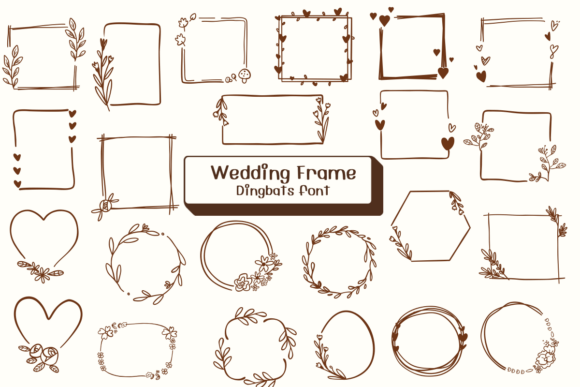
At its heart, Wedding Frame is a dingbats font, but not in the traditional sense of simple icons. It is a curated collection of hand-drawn, vector-based ornamental frames. Each character in the font corresponds to a different frame design, ranging from delicate floral wreaths and heart outlines to elegant geometric borders and romantic scrollwork. This format means the frames are infinitely scalable, maintaining crisp clarity whether used on a small favor tag or a large welcome sign.
The distinctiveness of Wedding Frame lies in its cohesive aesthetic. The collection is intentionally designed with a unified romantic and elegant style. This solves a common problem for designers and DIY creators: sourcing multiple decorative elements that look intentionally paired rather than mismatched. By using a single font, you ensure that the heart frame on your invitation suite, the circular border on your table numbers, and the geometric outline on your social media graphics all share the same artistic hand, creating visual harmony across your entire project.
Comparative Analysis: Dingbat Fonts vs. Other Design Resources
To properly evaluate Wedding Frame, it's helpful to compare it to the primary alternatives designers and couples consider.
Against Standalone Clip Art and Illustrations
Individual vector illustrations or PNG clip art packs are a common alternative. Their strength lies in variety and specificity; you can find a very particular flower or ornament. However, the tradeoff is inconsistency. Building a cohesive set from different artists or sources can be time-consuming and may result in mismatched line weights or styles. Wedding Frame offers the advantage of pre-curated consistency. The limitation is that you are working within the artist's defined collection, which may not include a highly specific motif you desire.
Against Full-Featured Design Software and Templates
Professional design software like Adobe Illustrator or online platforms like Canva provide immense control and access to vast libraries. Templates, in particular, offer a complete design structure. The tradeoff here is complexity and cost. For someone who wants to add a simple, elegant frame to a text-based invitation without learning complex software, Wedding Frame presents a lower barrier to entry. It functions like a specialized tool within any program that supports fonts. However, for projects requiring intricate customization of the frame elements themselves (e.g., changing the petal shape of a floral wreath), a fully editable vector illustration is more appropriate.
Against Physical Craft Supplies
In the realm of physical crafting, options include rubber stamps, stencils, and die-cuts. These are tactile and offer a handmade feel. The digital nature of Wedding Frame provides superior flexibility for last-minute changes, easy color modification, and flawless reproduction. For print projects, digital files are essential. The tradeoff is the loss of the textured, imperfection-charm that physical tools can impart. Wedding Frame is best suited for digital design or professional printing, while stamps excel in tangible, hands-on crafting.
Practical Applications and Best-Fit Scenarios
Understanding where Wedding Frame excels helps in making an informed decision. Its primary strengths emerge in specific contexts.
- DIY Wedding Stationery Suites: This is the quintessential use case. Creating a unified look across save-the-dates, invitations, RSVP cards, and details cards is streamlined. You can quickly apply a consistent frame to each piece, ensuring professional cohesion without a design degree.
- Digital Event Branding: For engagement announcements, wedding websites, social media headers, or digital invitations, Wedding Frame allows for easy integration. Its vector nature means it looks sharp on any screen.
- Crafting and Scrapbooking: For digital scrapbooking or creating printable templates for favors, tags, or programs, the font-based approach is highly efficient. It can be used in popular design tools and word processors.
- Small Business Branding: Businesses in the wedding industry—planners, photographers, bakers—can use these frames to add a touch of elegance to their own marketing materials, business cards, or thank-you notes.
Conversely, there are situations where another resource might be better. If your project demands a highly unique, one-of-a-kind illustration that doesn't exist in the font's set, commissioning a custom illustration is necessary. If you need a frame that wraps around complex, irregular text blocks with dynamic spacing, a pre-made font may be limiting compared to manually adjusting vector paths.
Key Decision Factors and Tradeoffs
When weighing Wedding Frame against other options, consider these factors:
- Design Consistency vs. Customization: Are you prioritizing a quick, cohesive look, or do you need to tweak every minute detail? Wedding Frame wins on consistency; custom illustrations win on absolute control.
- Budget and Time: A single font purchase is typically more cost-effective than buying multiple illustration packs or hiring a designer. It also significantly reduces design time for a complete suite.
- Technical Skill Level: The font is accessible to anyone who can change a font in a document. This makes it ideal for beginners or those under time pressure. Advanced users may find it a useful shortcut for initial layouts.
- Project Scale and Repetition: For projects where the same style of frame is used dozens of times (e.g., 200 identical program covers), the efficiency of a font is unparalleled. For a single, hero piece, more investment in a unique element may be justified.
- Aesthetic Alignment: The hand-drawn, romantic style of Wedding Frame is not universal. If your project's theme is ultra-modern, minimalist, or rustic in a way that clashes with floral motifs, it may not be the right stylistic fit.
Making an Informed Choice
Wedding Frame occupies a specific and valuable niche in the design toolkit. It is not a replacement for professional graphic design services or comprehensive design software. Instead, it is a powerful, specialized resource for executing a particular style with remarkable efficiency and consistency.
It is likely the right choice if your goal is to create a collection of coordinated items with a romantic, elegant, hand-crafted aesthetic, and you value speed and ease of use. It empowers non-designers to achieve a polished, professional look.
You may need to explore other options if your vision requires breaking outside the predefined aesthetic of the collection, demands pixel-level manipulation of the frame elements, or if your project's scope is better served by a full-service designer. Ultimately, the best tool is the one that aligns with your project's specific requirements, your skills, and your desired outcome. By understanding what Wedding Frame is—and what it isn't—you can make a confident choice for your next romantic design endeavor.