Transforming Education and Content Creation with Happy Trace: The Interactive Font Revolution
In the rapidly evolving landscape of digital education and content creation, the tools we use to communicate and instruct are undergoing a significant transformation. For educators, designers, and entrepreneurs, the demand for resources that are not only functional but also pedagogically sound and aesthetically engaging is higher than ever. Enter Happy Trace, a creative educational font designed specifically for alphabet practice, which is redefining how we approach worksheet creation and interactive learning. This is not merely a typeface; it is a comprehensive tool designed to bridge the gap between digital design and hands-on educational practice.
The Anatomy of Happy Trace: More Than Just Typography
At its core, Happy Trace addresses a specific but ubiquitous challenge in education: the creation of effective handwriting practice materials. Traditional methods often require teachers to manually draw lines or rely on clunky, inflexible templates. Happy Trace streamlines this process through a unique design architecture that integrates writing lines directly into the character set.
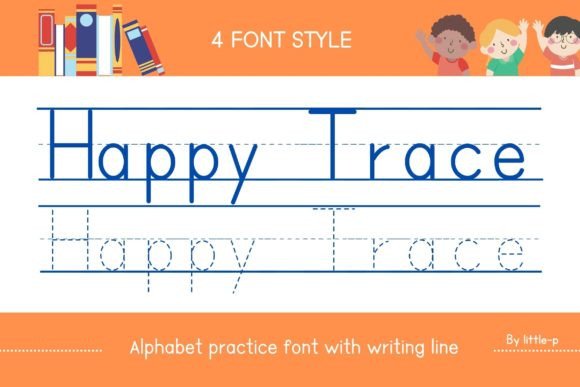
The font encompasses four distinct styles, each serving a specific pedagogical or design purpose:
- Regular: The foundational style, providing clear, legible letterforms that serve as a model for learners. This is ideal for standard reading materials or headers where a clean, educational aesthetic is required.
- Bold: A heavier weight designed for emphasis. In educational materials, bold fonts are crucial for highlighting key concepts or creating visual anchors for students who are just beginning to recognize letter shapes.
- Letter-line: This innovative style combines the letter with a dedicated writing line structure. It ensures that students have a consistent visual guide for letter height, baseline placement, and descender depth, effectively automating the creation of primary ruled lines.
- Dash-line: Perhaps the most interactive of the four, the Dash-line style renders letters as dotted or segmented outlines. This is the quintessential style for "trace and write" exercises, allowing students to physically connect the dots to form letters, thereby reinforcing muscle memory and stroke order.
The true genius of the system, however, lies in its integration of the space bar function. By utilizing the space bar to generate continuous writing lines, Happy Trace allows creators to bypass the tedious process of aligning separate line graphics. This feature ensures that spacing is mathematically consistent, which is vital for early learners developing their spatial awareness on the page.
Industry Trends: The Shift Toward Interactivity and Customization
The introduction of Happy Trace aligns perfectly with several broader industry trends affecting education and the digital marketplace. We are currently witnessing a significant shift away from static, one-size-fits-all educational materials toward dynamic, customizable content. Parents, homeschoolers, and classroom teachers are increasingly seeking resources that can be tailored to individual learning speeds and styles.
From a business perspective, the "Creator Economy" has empowered freelancers and entrepreneurs to monetize their educational expertise. Platforms like Teachers Pay Teachers or Etsy have created a booming market for high-quality digital downloads. However, the barrier to entry often lies in the technical skill required to design professional-looking worksheets. Happy Trace democratizes this process. By embedding the design logic into the font itself, it allows a subject matter expert—who may not be a graphic designer—to produce materials that look polished and pedagogical.
Furthermore, the rise of the "Phygital" experience—where physical and digital learning intersect—is reshaping expectations. While tablets and styluses are popular, research consistently shows that the tactile act of writing on paper remains essential for cognitive development and memory retention. Happy Trace supports this by facilitating the creation of high-quality printable materials that bridge the screen-to-paper gap. It allows educators to design digitally and print physically, catering to a market that values screen-free learning time.
Practical Applications: From Alphabets to Integrated Learning
While the primary application of Happy Trace is alphabet practice, its utility extends far beyond simple letter tracing. The versatility of the font makes it a powerful asset for creating a wide array of educational materials, including math problems, integrated subject worksheets, and creative journals.
Mathematics and Logic
Consider the challenge of creating math worksheets for young learners. Alignment is critical when teaching addition, subtraction, or place value. The dedicated writing lines provided by the Letter-line style can be repurposed to create perfectly aligned columns for numbers. Educators can use the font to generate number tracing exercises that mirror the rigor of the alphabet practice, ensuring consistency across the curriculum.
Cross-Curricular Integration
Modern pedagogy favors integrated learning—combining subjects to create a cohesive understanding. Happy Trace excels here. A teacher could create a science worksheet about the life cycle of a butterfly where the key vocabulary words are presented in the Dash-line style. This allows the student to learn the scientific concept while simultaneously practicing the spelling and handwriting of the relevant terminology. This dual-purpose approach maximizes learning efficiency, a key requirement in today’s time-constrained educational environments.
Entrepreneurial Opportunities
For freelancers and content creators, Happy Trace offers a unique value proposition. It allows for the rapid prototyping of educational products. A creator can quickly assemble a comprehensive workbook series—covering letters, numbers, and shapes—maintaining a consistent visual brand identity across all products. The ability to generate lines via the space bar drastically reduces production time, allowing creators to scale their digital product catalogs efficiently.
Addressing Changing Workflows and Expectations
The relevance of Happy Trace is also tied to the changing workflows of educators and content creators. In the past, creating a custom worksheet might involve complex software like Adobe Illustrator or InDesign, requiring significant technical overhead. Today’s professionals and enthusiasts demand tools that work seamlessly within familiar environments like word processors or basic design apps.
Because Happy Trace functions as a standard font file, it integrates into existing workflows without friction. There is no steep learning curve or proprietary software required. This accessibility meets the modern expectation of "plug-and-play" utility. It empowers teachers to spend less time on formatting and more time on curriculum development and student interaction.
Moreover, the aesthetic expectations of consumers have risen. Parents are no longer satisfied with grainy, photocopied worksheets from the 1990s. They expect clean lines, modern typography, and engaging layouts. Happy Trace delivers a contemporary aesthetic that appeals to modern sensibilities, making the learning materials feel fresh and inviting. This visual appeal is crucial for maintaining student engagement, particularly for younger learners who are drawn to colorful and well-organized materials.
The Future of Educational Design
Looking forward, tools like Happy Trace represent a move toward "intelligent design assets." We are moving beyond static files and toward resources that assist in the creation process itself. By automating the tedious aspects of layout—such as line generation and spacing—creators are freed to focus on the content and the pedagogical strategy.
For the professional creator or the dedicated educator, the value of Happy Trace lies in its ability to enhance the learning experience while simplifying the creation process. It serves as a reminder that innovation in education technology doesn't always have to be complex or AI-driven; sometimes, the most effective innovation is a smarter, more thoughtful approach to the fundamental tools we use every day.
In conclusion, Happy Trace is more than just a font; it is a strategic tool for the modern educational landscape. It addresses the practical needs of handwriting practice, aligns with the market demand for customizable digital products, and supports the cognitive benefits of tactile learning. Whether you are a teacher looking to streamline your prep time, a parent seeking better practice sheets for your child, or an entrepreneur building a brand in the educational space, Happy Trace offers a robust, flexible, and forward-looking solution.