The Enduring Appeal of Handwritten Fonts: Why Brittany is Capturing the Creative Market
In an era saturated with digital precision and algorithmic perfection, a quiet rebellion is brewing in the world of design. It’s a move away from the sterile, the uniform, and the predictable. Professionals, entrepreneurs, and creators are actively seeking ways to infuse their digital presence with warmth, authenticity, and a distinctly human touch. This is the context in which the Brittany handwritten font has emerged not just as a typeface, but as a strategic tool for connection. More than just a collection of beautifully crafted letters, Brittany represents a conscious shift in visual communication, aligning with a deeper consumer desire for brands that feel personal, genuine, and timeless.
Understanding the Brittany Font: More Than Just Script
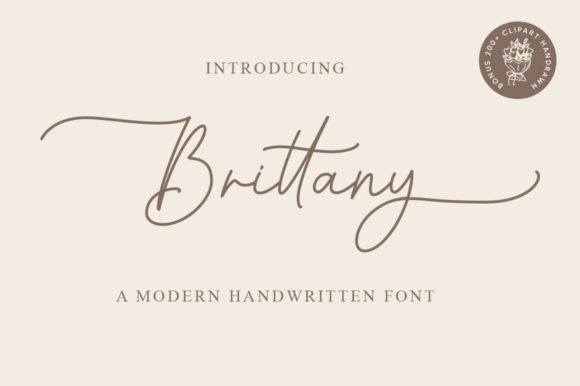
At its core, Brittany is a lovely and timeless handwritten font. Its design philosophy is rooted in the organic flow of natural handwriting, featuring elegant swashes, ligatures, and a rhythm that feels both spontaneous and carefully composed. This balance is crucial. It avoids the potential chaos of a purely freeform script while steering clear of the rigidity of a standard serif or sans-serif. The result is a typeface that carries inherent personality—it feels crafted by a human hand, which immediately sets it apart in a landscape dominated by machine-perfect fonts.
A critical technical feature that elevates Brittany from a mere aesthetic choice to a practical professional asset is its PUA encoding. PUA, or Private Use Area encoding, is a standard that allows fonts to include special characters and glyphs that are not part of the standard keyboard layout. For the user, this means that accessing the full suite of stylistic alternates, swashes, and ligatures designed to accompany Brittany is seamless. With a simple click in a compatible design program—be it Adobe Illustrator, Photoshop, or even Canva—a creator can transform a simple word into a unique typographic piece. This accessibility is paramount, as it democratizes high-end design features, allowing freelancers and small business owners to achieve a level of customization previously reserved for those with deep technical expertise.
Fitting into the Macro Trends: Authenticity and the Creator Economy
The rise of fonts like Brittany is not an isolated event; it is a direct response to several converging industry trends. The most significant of these is the global pivot towards authentic branding. Consumers, particularly millennials and Gen Z, are increasingly skeptical of polished, corporate-sounding marketing. They respond to stories, to perceived transparency, and to brands that feel like they were started by a real person with a real passion. A handwritten font like Brittany is a powerful visual cue for this authenticity. It subtly communicates that a brand is approachable, creative, and values the personal touch.
This trend is amplified by the explosive growth of the creator economy. Entrepreneurs, influencers, and freelancers are building personal brands where their unique identity is the product. In this context, visual consistency is not about sterile uniformity but about creating a recognizable "vibe." Brittany serves as an excellent tool for this. A logo set in Brittany, used consistently across social media graphics, website headers, and email signatures, creates a cohesive and memorable brand aesthetic. It helps a solopreneur stand out in a crowded digital marketplace by signaling a specific, handcrafted quality.
Changing Workflows and Evolving Design Expectations
The modern creative workflow is characterized by a need for both speed and quality. Tools have evolved to meet this demand. The prevalence of powerful, user-friendly design platforms has put sophisticated design capabilities into the hands of non-designers. This shift in accessibility has changed user expectations. It’s no longer enough for a font to simply look good; it must also be easy to use.
This is where Brittany's practicality shines. The PUA encoding directly addresses the modern workflow. A marketer creating a series of Instagram quotes doesn't have time for complex workarounds. They need to be able to highlight a word, select an alternate glyph from a simple dropdown menu, and move on. This ease of use ensures that the font's advanced features are not just theoretical but are actively utilized, leading to more dynamic and professional-looking results. The expectation has moved from "what can this font do?" to "how quickly and easily can I make it do it?" Brittany answers this perfectly.
Practical Applications: Where Brittany Truly Shines
The versatility of a well-designed handwritten font is one of its greatest strengths. Its application spans numerous creative and commercial fields, each benefiting from its unique character.
- Logo and Brand Identity: This is Brittany's most prominent use case. For businesses in the wedding industry, boutique retail, artisanal food, coaching, or any creative service, a Brittany-based logo instantly conveys a sense of elegance, care, and bespoke quality. It suggests that the product or service is not mass-produced but is thoughtfully created.
- Social Media and Content Marketing: In the fast-scrolling environment of social media, eye-catching visuals are essential. Using Brittany for pull-quotes, call-to-action text, or headlines on graphics can stop a user in their tracks. Its organic form provides a beautiful contrast to clean sans-serif body text, creating a visual hierarchy that is both effective and aesthetically pleasing.
- Print and Packaging Design: The timelessness of the font makes it a superb choice for physical products. Imagine it on the label of a small-batch candle, the packaging for a gourmet coffee blend, or the thank-you card included in an e-commerce order. These tactile moments of brand interaction are powerful, and a font like Brittany enhances the feeling of receiving something special and personal.
- Digital Products and Quotes: For creators who sell digital goods or simply share inspirational content, Brittany provides the perfect typographic voice. It can elevate a simple quote into a piece of shareable art, adding emotional weight and visual appeal that a standard font cannot.
Why the Focus on Brittany? A Synthesis of Form and Function
With countless handwritten fonts available, one might ask why a font like Brittany garners specific attention. The answer lies in its successful synthesis of aesthetic appeal and functional utility. Many script fonts fall into one of two camps: they are either beautiful but illegible, or they are practical but lack personality. Brittany navigates this challenge effectively.
Its letterforms are designed for clarity, ensuring that even when used for short phrases, the words remain readable. This is a critical consideration for branding, where a logo must be instantly recognizable. Simultaneously, its extensive set of stylistic alternates allows for a high degree of customization. This prevents the "cookie-cutter" effect that can happen when a popular font is used by many. Two designers using Brittany can create vastly different looks by leveraging different swashes and ligatures, ensuring their work remains unique.
Furthermore, the choice of a font is an emotional one. It sets the tone for a brand before a single word of copy is read. Brittany’s tone is one of elegance, approachability, and creativity. It doesn’t shout; it invites. This subtle emotional resonance is what makes it so effective for professionals who want to build a relationship with their audience, not just sell them a product.
Connecting to Larger Developments in Design and Technology
The appreciation for fonts like Brittany is part of a larger movement in design that seeks to blend the digital and the analog. In a world of flat design and minimalist interfaces, there is a growing appreciation for texture, depth, and the imperfect beauty of handmade things. Handwritten fonts are a digital artifact that captures this spirit. They are a way to embed a sense of craft and care directly into the pixels of a website or the vectors of a logo.
As technology continues to advance, with AI-generated art and hyper-realistic rendering becoming commonplace, the value of the human touch will only increase. Fonts that emulate the warmth and variability of human handwriting will become even more significant markers of authenticity. They serve as a reminder that behind every brand, every product, and every piece of content, there are people. The Brittany font, with its timeless design and user-friendly implementation, is perfectly positioned to serve this ongoing need for connection in an increasingly digital world. It is not merely a trend, but a response to a fundamental human desire for beauty, personality, and authenticity in every interaction.